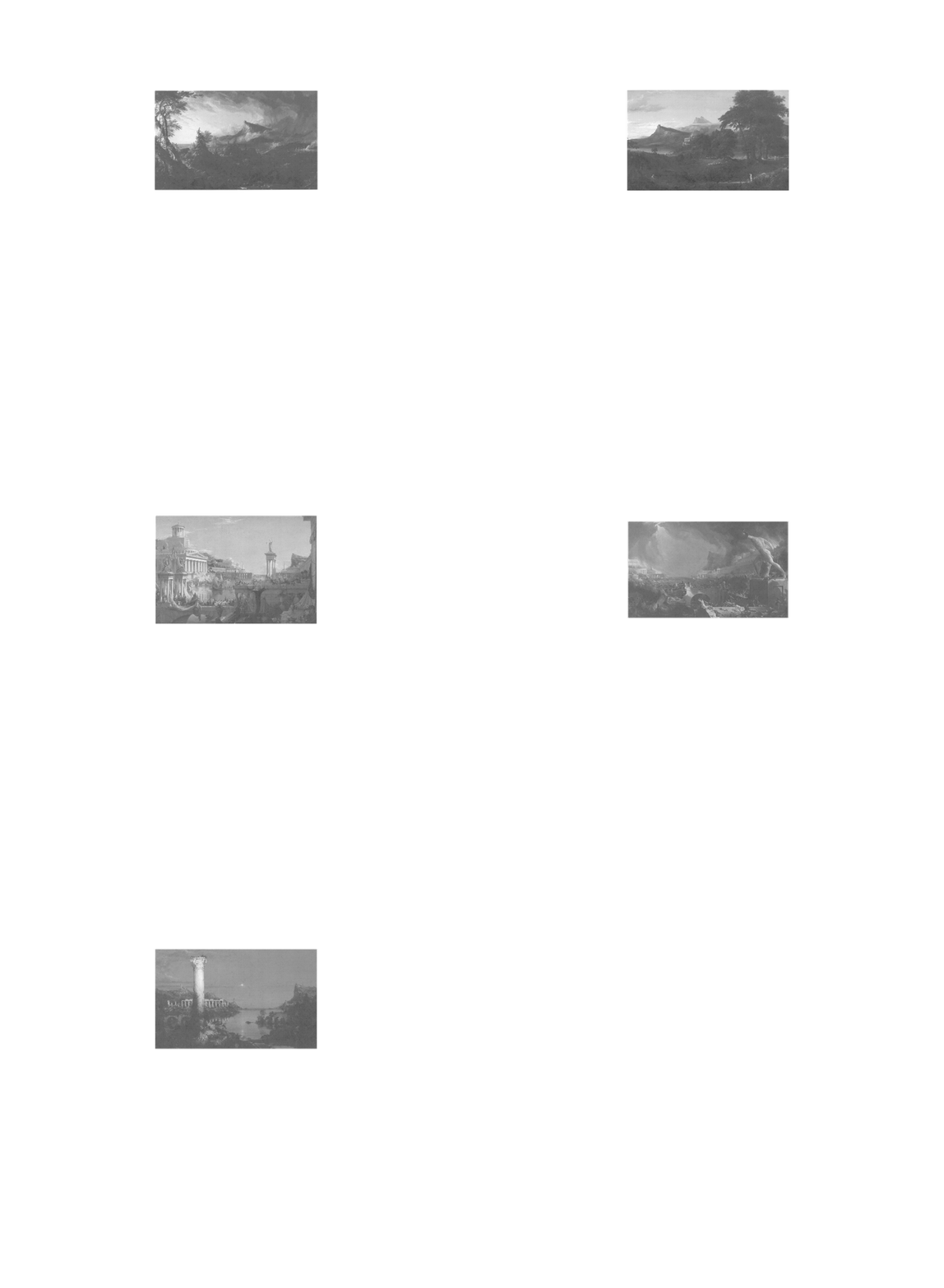
Thomas Cole
let him visit the fine picture of
“The Angels appearing to the
Shepherds,” by COLE.
The
subject
is suited to the peculiar
state of every mind which has
been agitated at the sight of the
recent outbreakings of sin and war,
and ill-will among brethren.
Writing in the wake
of the April 1834 election riot, a
three-day affair that broke out
around that year’s mayoral election
in New York, the Commercial
Advertiser critic championed
Cole’s picture as a symbolic
answer to the “stirring strife of
political war.” The painting, in this
argument, could work to “subdue”
the violent “passions” at the
root of the riots, bring peaceable
“repose” to the agitated viewer,
rebuild the bonds of good “will”
joining the city’s “brethren,” and
ultimately work to rebuild an
orderly and harmonious “public.”
In celebrating Cole’s
picture as a vehicle for edification,
pacification, and harmonization, the
Commercial Advertiser review
articulated the central themes of
a broader aesthetic discourse that
circulated widely in the antebellum
period. This discourse, which I
will call “republican aesthetics,”
construed elevated painting as a
medium through which an ideal
mode of hierarchical republicanism
might be articulated, realized, and
sustained in the face of growing
disorder and the accelerating
process of democratization.
Proponents of republican
aesthetics understood academic
painting as an exemplary vehicle
for the transmission of republican
behaviors and attitudes, an engine
for the reproduction of customary
hierarchies, and a connective tissue
that might rebuild civic bonds.
As the review quoted above
suggests, these arguments found
expression in a wide range of
cultural venues and maintained
their force long after the political
system began its radical shift
toward popular democracy in the
Jacksonian era. The review also
affords a view of the pressures
that this aesthetic discourse
brought to bear on the production
and consumption of elevated art
at the time. Encouraging artists
and audiences alike to focus
on subjects that might reaffirm
traditional civic ideals, republican
aesthetic theory attempted
to foreclose the possibility of
representing alternative forms of
civic expression and governance in
paint--including mass democracy
and politicized violence. Most
artists accordingly chose to ignore
the turbulent phenomena that
threatened the republican polity
and instead focused on rendering
the spaces and figures of elite
governance.
Painting the period’s endemic
disorder in this highly charged
context was a difficult and
risky venture. In taking up the
subject of upheaval, Cole had
few precedents on which to
draw, little critical support, and
a difficult theoretical problem
to surmount: how to represent
the illicit phenomenon of violent
turmoil in a medium ideologically
aligned with order. This essay
will examine Destruction as a
pioneering effort to negotiate the
pressures of republican aesthetics
and open symbolic space for the
representation of unrest within the
visual field of academic painting.
On its surface a depiction of a
military battle set in an imagined
ancient past, Destruction shapes a
vision of roiling chaos that subtly
invokes the rioting that surrounded
the artist in New York in the early
1830s. To answer contemporary
critical demands for stabilizing
imagery, I will argue, Cole drew
on the themes of the political
jeremiad, a prophetic rhetorical
mode that American conservatives
employed to underscore the virtue
of harmony and hierarchy. As he
composed his jeremiad in paint,
Cole strove to reaffirm the ideals
of hierarchical republicanism and
conjure up the dramatic energy
of the upheaval around him. The
arresting scene that resulted,
however, points to an unresolved
mixture of feelings at the heart
of the jeremiadical tradition, a
deep ambivalence about turmoil
that complicated conservative
arguments for order and authority.
By reconstructing Cole’s
negotiations with republican
aesthetics and his carefully
refracted engagement with
Jacksonian unrest, this essay aims
As a young artist working in
New York in the late 1820s and
early 1830s, Thomas Cole was
confronted by a steady stream of
political turmoil. The city was a
major hub for the raucous culture
of mass politics that had begun
to develop around the Democratic
Party. New York’s elections in the
Jacksonian era were increasingly
turbulent affairs in which
contending factions employed
mass demonstrations, acts of
intimidation, and polling-place
brawls in an effort to influence
voting. In these years the city was
also the site of frequent bloody
riots, many political in nature; by
one estimate, New York witnessed
seventy-four riots between 1828
and 1836.l As we will see, Cole
kept close tabs on the democratic
tumult that surged around him.
At the height of this unrest, I will
argue, he turned to the spectacle of
upheaval for inspiration. Hard at
work on his monumental cycle The
Course of Empire (1834-36) even
as the wave of Jacksonian violence
crested, Cole inscribed the fourth
canvas, Destruction (frontispiece),
with a glowing vision of disorder
that invoked and sensationally
dramatized the riotous energies of
the moment.
Cole’s creative
engagement with Jacksonian
disorder entailed a daring
departure from convention. Indeed,
the artist’s viewers expected his
work to function as a corrective
to the turmoil of the era. An 1834
New-York Commercial Advertiser
review of Cole’s painting The
Angel Appearing to the Shepherds
thus argued:
The political excitement
through which we have passed,
seems to have absorbed all
interests but one. Objects worthy
of attentive study, and of real
public interest have been forgotten.
We have now a breathing spell,
and after such a stirring of the
passions, what subjects can we
fix upon to calm the feelings, and
bring repose
than the silent yet
eloquent lessons of the pictorial
art? If anyone would feel this
delightful calm, if he would have
those passions which have been
over-excited by the stirring strife
of political war
subdued by
to shed new light on the complex
interconnections between aesthetic
theory, painting, and political
conflict in the early nineteenthcentury
United States. I also hope
to extend and redirect scholarly
considerations of The Course
of Empire, which have thus far
concentrated on Consummation,
the third and largest canvas of
the series. More specifically, I seek
to build on and complicate the
insightful studies of Alan Wallach
and Angela Miller, who have read
Cole’s series as an allegorical
critique of Jacksonian imperial
ambition and commercial excess
that posits an inescapably bleak
fate for the nation. Diverging from
these analyses, I will argue that
Cole’s creative engagement with
the political jeremiad opened space
for the viewer to look beyond the
surface narrative of inexorable
decline and understand The
Course of Empire as a cautionary
prophecy of an unsettling but
avoidable national future.
Republican Aesthetics
Early nineteenth-century artists
and critics regularly stressed the
power of academic painting to
sustain the fledgling republican
polity by communicating
its central ideals, making its
structures visible and “real”
to viewers, and establishing
republicanism as the limit of
political possibility for the new
nation. Articulated by a variety
of cultural commentators, these
arguments gradually cohered into
a consistent theoretical discourse
that would profoundly influence
the production and consumption
of political art in the Jacksonian
period and deeply complicate the
painterly representation of popular
democracy and violent discord.
The first few decades of the
nineteenth century saw the
establishment of a hierarchical
republican polity and its gradual
displacement by the modern
liberal-democratic system that
would shape American life
for the rest of the century.
Laboring to contain the disorderly
potential of the masses, the
framers of the Constitution had
designed a republican system
of representation that delegated
political authority, as James
Madison argued in Federalist 10,
to an elite “body of citizens, whose
wisdom may best discern the true
interest of their country.” Taking
shape in the following decades,
this system featured a civic
sphere defined by order, communal
harmony, and rigid hierarchy.
When navigating this arena,
citizens of the early republic were
expected to relinquish disorderly
crowd traditions (such as rioting,
skimmington rides, and tarring
and feathering) and confine the
expression of political opinion to
peaceable practices (voting, debate,
and petitioning), cede authority
over public concerns to elected
officials, and defer to the superior
administrative capacities of these
statesmen.
This early hierarchical
republic was challenged from
its inception by a variety of
populist uprisings and democratic
movements. A wide range of
Americans still understood violent
action as a legitimate means
of political expression and an
instrument of communal will.
This lingering attachment to
force fueled a string of bloody
outbursts that culminated in
the wave of rioting that swept
the nation in the late 1820s and
early 1830s. Workers, women, and
northern freedmen simultaneously
employed new forms of orderly
collective action (such as parades,
demonstrations, and public
meetings) in an effort to widen the
sphere of political agency, spurring
the expansion of the franchise
and the emergence of mass party
politics.5
Early cultural spokesmen
imagined academic painting and
sculpture as key supports for the
shifting and contested polity. These
arguments rehearsed and renovated
the central ideas of European
aesthetics and especially the
theories of Sir Joshua Reynolds
and other neoclassical thinkers. As
John Barrell has shown, Reynolds’s
enormously influential Discourses
construed art as a cultural
vehicle capable of developing a
virtuous citizenry by stimulating
viewers’ higher faculties and
civic inclinations. Extending
Reynolds’s ideas, American thinkers
emphasized painting’s capacity
to communicate the central
attitudes necessary for correct
republican citizenshi p and to
temper those impulses believed
to promote disorder. Regularly
affirming painting’s power to
“enhance the charms of virtue”
or offer concrete “incitement[s] to
virtue,” aesthetic writers aligned
the medium with a central civic
trait associated with reasonable
self-control and communitymindedness.
Even as it stimulated
those propensities necessary
for partici pation in the political
sphere, painting also worked
to restrain the lower psychic
impulses that purportedly gave
rise to factionalism, mob violence,
and other forms of unrest. In
an 1813 article promoting the
American Academy of the Fine
Arts, for example, the lawyer
John G. Bogert argued that
artworks exhibited at the fledgling
institution would “soften the
fiercer passions
create an
admiration of whatever is great
and glorious, and
bring into
exercise all the finer feelings of
our nature.”6 In aligning painting
with the development of virtuous
self-disci pline and the defusing of
the “fiercer passions,” Bogert and
countless other aesthetic thinkers
positioned the medium as a critical
bulwark against the turbulence
that threatened the early republic.
Just as they sought
to define the ordering and
harmonizing effects of academic
art, early nineteenth-century arts
advocates identified subjects
they felt would most effectively
communicate the tenets of
hierarchical republicanism.
Almost invariably, critics and
cultural commentators urged
artists to concentrate on the
figures and practices of elite
leadership. An 1816 North
American Review article, for
example, argued that art devoted
to “the actions of our great
and good men” would “prompt
citizens to illustrious deeds of
heroism or benevolence.” In a
contemporaneous academic lecture,
the politician DeWitt Clinton
called for the establishment of
a gallery of “illustrious men” in
New York, which might inspire
visitors “to rouse the soul of
generous emulation, and to catch