Russian Revoloution
The russian revolution of
1917 was not an event or even
a process, but a sequence of
disruptive and violent acts that
occurred more or less concurrently
but involved actors with differing
and in some measure contradictory
objectives. It began as a revolt of
the most conservative elements in
Russian society, disgusted by the
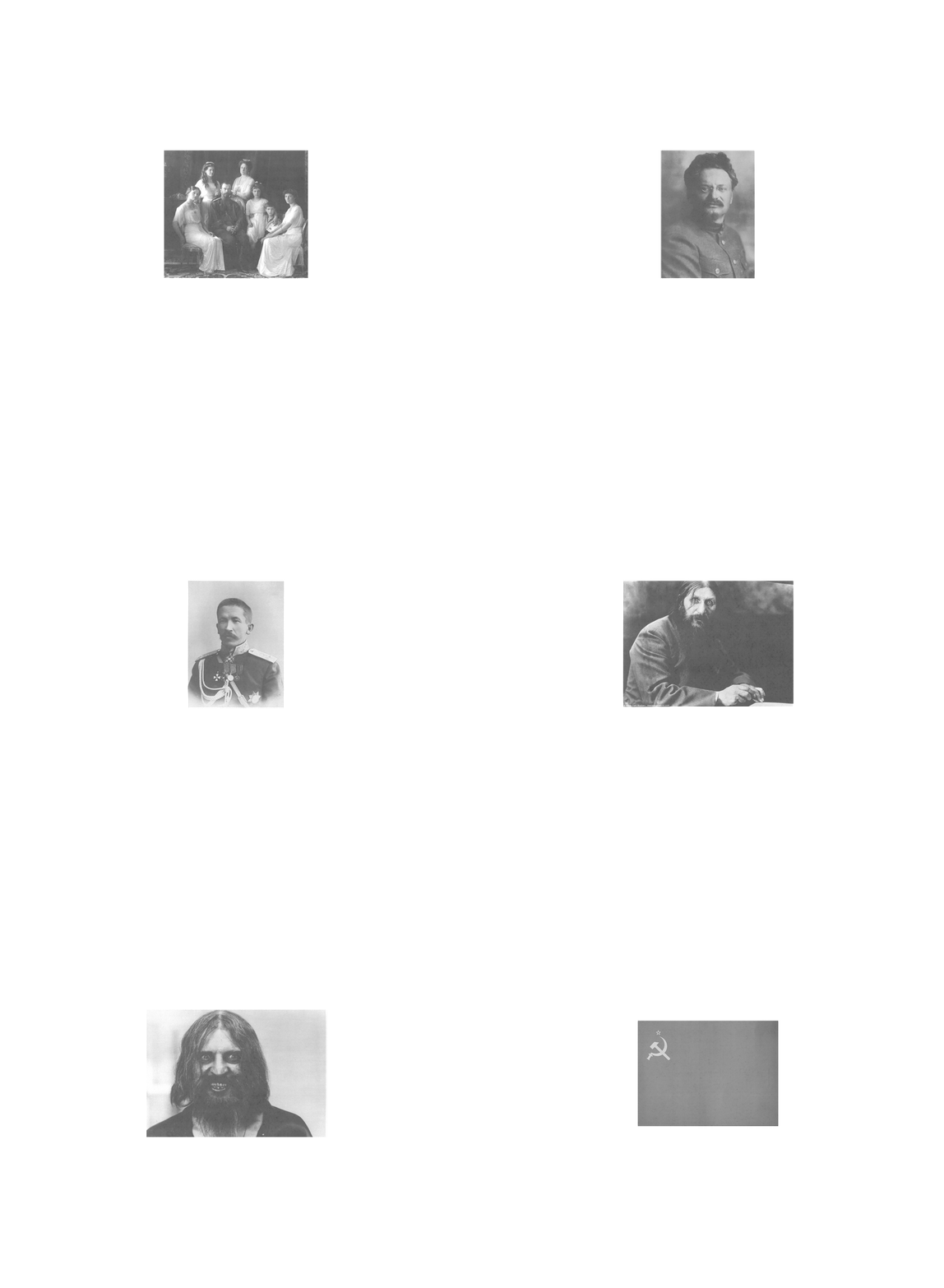
Crown’s familiarity with Rasputin
and the mismanagement of the
war effort. From the conservatives
the revolt spread to the liberals,
who challenged the monarchy
from fear that, if it remained in
office, revolution would become
inevitable. Initially, the assault on
the monarchy was undertaken not,
as widely believed, from fatigue
with the war but from a desire to
pursue the war more effectively:
not to make revolution but to avert
one. In February 1917, when the
Petrograd garrison refused to fire
on civilian crowds, the generals,
in agreement with parliamentary
politicians, hoping to prevent the
mutiny from spreading to the
front, convinced Tsar Nicholas II
to abdicate. The abdication, made
for the sake of military victory,
brought down the whole edifice of
Russian statehood.
Although initially neither
social discontent nor the agitation
of the radical intelligentsia
played any significant role in
these events, both moved to the
forefront the instant imperial
authority collapsed. In the spring
and summer of 1917, peasants
began to seize and distribute
among themselves non-communal
properties. Next, the rebellion
spread to frontline troops, who
deserted in droves to share in
the spoils; to workers, who took
control of industrial enterprises;
and to ethnic minorities, who
wanted greater self-rule. Each
group pursued its own objectives,
but the cumulative effect of their
assault on the country’s social and
economic structure by the autumn
of 1917 created in Russia a state
of anarchy.
The events of 1917
demonstrated that for all its
immense territory and claim to
great power status, the Russian
Empire was a fragile, artificial
structure, held together not by
organic bonds connecting rulers
and ruled, but by mechanical
links provided by the bureaucracy,
police, and army. Its 150 million
inhabitants were bound neither
by strong economic interests nor
by a sense of national identity.
Centuries of autocratic rule in
a country with a predominantly
natural economy had prevented
the formation of strong lateral
ties: Imperial Russia was mostly
warp with little woof. This fact
was noted at the time by one of
Russia’s leading historians and
political figures, Paul Miliukov:
To make you understand
[the] special character of the
Russian Revolution, I must
draw your attention to [the]
peculiar features, made our
own by the whole process of
Russia’s history. To my mind,
all these features converge into
one. The fundamental difference
which distinguishes Russia’s
social structure from that of
other civilized countries, can be
characterized as a certain weakness
or lack of a strong cohesion or
cementation of elements which
form a social compound. You can
observe that lack of consolidation
in the Russian social aggregate
in every aspect of civilized life:
political, social, mental and national.
From the political point of view, the
Russian State institutions lacked
cohesion and amalgamation with
the popular masses over which
they ruled....As a consequence of
their later appearance, the State
institutions in Eastern Europe
necessarily assumed certain forms
which were different from those in
the West. The State in the East
had no time to originate from
within, in a process of organic
evolution. It was brought to the
East from outside.
Once these factors are taken
into consideration, it becomes
apparent that the Marxist notion
that revolution always results
from social (“class”) discontent
cannot be sustained. Although such
discontent did exist in Imperial
Russia, as it does everywhere, the
decisive and immediate factors
making for the regime’s fall
and the resultant turmoil were
overwhelmingly political.
Was the Revolution
inevitable? It is natural to believe
that whatever happens has to
happen, and there are historians
who rationalize this primitive faith
with pseudo-scientific arguments:
they would be more convincing
if they could predict the future
as unerringly as they claim to
predict the past. Paraphrasing a
familiar legal maxim, one might
say that psychologically speaking,
occurrence provides nine-tenths
of historical justification. Edmund
Burke was in his day widely
regarded as a madman for
criticizing the French Revolution:
seventy years later, according to
Matthew Arnold, his ideas were
still considered “superannuated and
conq uered by events”--so ingrained
is the belief in the rationality,
and therefore the inevitability, of
historical events. The grander
they are and the more weighty
their consequences, the more they
appear part of the natural order
of things that it is quixotic to
question.
The most that one can
say is that a revolution in Russia
was more likely than not, and this
for several reasons. Of these,
perhaps the most weighty was
the steady decline of the prestige
of tsardom in the eyes of a
population accustomed to being
ruled by an invincible authority--
indeed, seeing in invincibility the
criterion of legitimacy. After a
century and a half of military
victories and expansion, from the
middle of the nineteenth century
until 1917, Russia suffered one
humiliation after another at the
hands of foreigners: the defeat,
on her own soil, in the Crimean
War; the loss at the Congress
of Berlin of the fruits of victory
over the Turks; the debacle in the
war with Japan; and the drubbing
at the hands of the Germans in
World War I. Such a succession of
reverses would have damaged the
reputation of any government: in
Russia it proved fatal.
Tsarism’s disgrace was
compounded by the concurrent
rise of a revolutionary movement
that it was unable to quell despite
resort to harsh repression. The
half-hearted concessions made
in 1905 to share power with
society neither made tsarism more
popular with the opposition nor
raised its prestige in the eyes of
the people at large, who simply
could not understand how a true
sovereign would allow himself
to be abused from the forum of
a government institution. The
Confucian princi ple of T’ien-ming,
or Mandate of Heaven, which in its
original meaning linked the ruler’s
authority to righteous conduct,
in Russia derived from forceful
conduct: a weak ruler, a “loser,”
forfeited it. Nothing could be more
misleading than to judge a Russian
head of state by the standard of
either morality or popularity: what
mattered was that he inspire fear
in friend and foe--that, like Ivan
IV, he deserve the sobriquet of
“Awesome.” Nicholas II fell not
because he was hated but because
he was held in contempt.
Among the other factors making
for revolution was the mentality
of the Russian peasantry, a class
never integrated into the political
structure. Peasants made up 80
percent of Russia’s population;
and although they took hardly
any active part in the conduct of
state affairs, in a passive capacity,
as an obstacle to change and,
at the same time, a permanent
threat to the status quo, they
were a very unsettling element.
It is commonplace to hear that
under the old regime the Russian
peasant was “oppressed,” but it
is far from clear just who was
oppressing him. On the eve of the
Revolution, he enjoyed full civil and
legal rights; he also owned, either
outright or communally, ninetenths
of the country’s agricultural
land and the same proportion
of livestock. Poor by Western
European or American standards,
he was better off than his father,
and freer than his grandfather,
who more likely than not had
been a serf. Cultivating allotments
assigned to him by fellow peasants,
he certainly enjoyed greater
security than tenant farmers of
Ireland, Spain, or Italy.
The problem with Russian
peasants was not oppression, but
isolation. They were isolated from
the country’s political, economic,
and cultural life, and therefore
unaffected by the changes that had
occurred since the time that Peter
the Great had set Russia on the
course of Westernization. Many
contemporaries observed that the
peasantry remained steeped in
Muscovite culture: culturally it
had no more in common with the
ruling elite or the intelligentsia
than the native population of
Britain’s African colonies had with
Victorian England. The majority of
Russia’s peasants descended from
serfs, who were not even subjects,
since the monarchy abandoned
them to the whim of the landlord
and bureaucrat. As a result, for
Russia’s rural population the state
remained even after emancipation
an alien and malevolent force that
took taxes and recruits but gave
nothing in return. The peasant
knew no loyalty outside his
household and commune. He felt
no patriotism and no attachment
to the government save for a
vague devotion to the distant tsar
from whom he expected to receive
the land he coveted. An instinctive
anarchist, he was never integrated
into national life and felt as much
estranged from the conservative
establishment as from the radical
opposition. He looked down on the
city and on men without beards:
the French traveler, Marquis de
Custine, heard it said as early as
1839 that someday Russia would
see a revolt of the bearded against
the shaven. The existence of this
mass of alienated and potentially
explosive peasants immobilized
the government, which believed
that it was docile only from fear
and would interpret any political
concessions as a signal to rebel.
The traditions of serfdom
and the social institutions of rural
Russia--the joint family household
and the almost universal system of
communal landholding--prevented
the peasantry from developing
qualities required for modern
citizenship. While serfdom was
not slavery, the two institutions
had this in common that, like
slaves, serfs had no legal rights and
hence no sense of law. Michael
Rostovtseff, Russia’s leading
historian of classical antiquity and
an eyewitness of 1917, concluded
that serfdom may have been
worse than slavery in that a serf
had never known freedom, which
prevented him from acquiring the
qualities of a true citizen: in his
opinion, it was a princi pal cause of
bolshevism. To serfs, authority was
by its very nature arbitrary: and
to defend themselves from it they
relied not on appeals to legal or
moral rights, but on cunning. They
could not conceive of government
based on princi ple: life to them was
a Hobbesian war of all against all.
This attitude fostered despotism:
for the absence of inner disci pline
and respect for law required order
to be imposed from the outside.
When despotism ceased to be viable,
anarchy ensued; and once anarchy
had run its course, it inevitably gave
rise to a new despotism.
The peasant was
revolutionary in one respect only:
he did not acknowledge private
ownership of land. Although on
the eve of the Revolution he owned
nine-tenths of the country’s arable,
he craved for the remaining 10
percent held by landlords, merchants,
and noncommunal peasants. No
economic or legal arguments could
change his mind: he felt he had a
God-given right to that land and
that someday it would be his. And
by his he meant the commune’s,
which would allocate it justly to
its members. The prevalence of
communal landholding in European
Russia was, along with the legacy
of serfdom, a fundamental fact of
Russian social history. It meant
that, along with a poorly developed
sense for law, the peasant also had
little respect for private property.
Both tendencies were exploited and
exacerbated by radical intellectuals
for their own ends to incite the
peasantry against the status quo.
Russia’s industrial workers were
potentially destabilizing, not because
they assimilated revolutionary
ideologies--very few of them did
and even they were excluded
from leadershi p positions in the
revolutionary parties. Rather, since
most of them were one or at most
two generations removed from
the village and only superficially
urbanized, they carried with them
to the factory rural attitudes only
slightly adjusted to industrial
conditions. They were not socialists
but syndicalists, believing that as
their village relatives were entitled to all the land, so
they had a right to the factories. Politics interested
them no more than it did the peasants: in this sense,
too, they were under the influence of primitive,
non-ideological anarchism. Furthermore, industrial
labor in Russia was numerically too insignificant
to play a major role in revolution: with at most 3
million workers (a high proportion of them peasants
seasonally employed), they represented a mere 2
percent of the population. Hordes of graduate
students, steered by their professors, in the Soviet
Union as well as the West, especially the United States,
have assiduously combed historical sources in the hope
of unearthing evidence of worker radicalism in prerevolutionary
Russia. The results are weighty tomes,
filled with mostly meaningless events and statistics,
that prove only that while history is always interesting,
history books can be both vacuous and dull.
A major and arguably decisive factor
making for revolution was the intelligentsia, which in
Russia attained greater influence than anywhere else.
The peculiar “ranking” system of the tsarist civil
service excluded outsiders from the administration,
estranging the best-educated elements and making
them susceptible to fantastic schemes of social reform,
conceived but never tried in Western Europe. The
absence until 1906 of representative institutions and
a free press, combined with the spread of education,
enabled the cultural elite to claim the right to speak
on behalf of a mute people. There exists no evidence
that the intelligentsia actually reflected the opinion
of the “masses”: on the contrary, the evidence
indicates that both before and after the Revolution
peasants and workers deeply mistrusted intellectuals.
This became apparent in 1917 and the years that
followed. But since the true will of the people had
no means of expression--at any rate, until the shortlived
constitutional order introduced in 1906--the
intelligentsia was able with some success to pose as
its spokesman.
As in other countries where it lacked legitimate
political outlets, the intelligentsia in Russia constituted
itself into a caste: and since ideas were what
gave it identity and cohesion, it developed extreme
intellectual intolerance. Adopting the Enlightenment
view of man as nothing but material substance
shaped by the environment, and its corollary, that
changes in the environment inevitably change human
nature, it saw “revolution” not as the replacement
of one government by another, but as something
incomparably more ambitious: a total transformation
of the human environment for the purpose of creating
a new breed of human beings--in Russia, of course,
but also everywhere else. Its stress on the inequities
of the status quo was merely a device for gaining
popular support: no rectification of these inequities
would have persuaded radical intellectuals to give up
their revolutionary aspirations. Such beliefs linked
members of various leftwing parties: anarchists,
Socialists-Revolutionaries, Mensheviks, and Bolsheviks.
Although couched in scientific terms, their views were
immune to contrary evidence, and hence more akin to
religious faith.
The intelligentsia, defined as intellectuals
craving power, stood in total and uncompromising
hostility to the existing order: nothing the tsarist
regime could do short of committing suicide would
have satisfied it. They were revolutionaries not for the
sake of improving the condition of the people but for
the sake of gaining domination over the people and
remaking them in their own image. They confronted
the Imperial regime with a challenge that it had no
way of repulsing short of employing the kind of
methods introduced later by Lenin. Reforms, whether
those of the 1860s, or those of 1905-6, only whetted
the appetite of the radicals and spurred them to still
greater revolutionary excesses. Buffeted by peasant
demands and under direct assault from the radical
intelligentsia, the monarchy had only one means of
averting collapse, and that was to broaden the base
of its authority by sharing power with conservative
elements of society. Historic precedent indicates that
successful democracies have initially limited power
sharing to the upper orders; these eventually came
under pressure from the rest of the population, with
the result that their privileges turned into common
rights. Involving conservatives, who were far more
numerous than the radicals, in both decision making
and administration would have forged something
of an organic bond between the government and
society, assuring the crown of support in the event
of upheavals and, at the same time, isolating the
radicals. Such a course was urged on the monarchy
by some farsighted officials and private individuals.
It should have been adopted in the 1860s, at the
time of the Great Reforms, but it was not. When
finally compelled in 1905 by a nationwide rebellion
to concede a parliament, the monarchy no longer had
this option available, for the combined liberal and
radical opposition forced it to concede something
close to a democratic franchise. This resulted in
the conservatives in the Duma being submerged by
militant intellectuals and anarchist peasants.
World War I subjected every belligerent country
to immense strains, which could be overcome only
by close collaboration between government and
citizenry in the name of patriotism. In Russia such
collaboration never materialized. As soon as military
reverses dissi pated the initial patriotic enthusiasm and
the country had to brace for a war of attrition, the
tsarist regime found itself unable to mobilize public
support. Even its admirers agree that at the time of
its collapse the monarchy was hanging in the air.
The motivation of the tsarist regime in
refusing to share political power with its supporters,
and when finally forced to do so, sharing it grudgingly
and deceitfully, was complex. Deep in their hearts, the
Court, the bureaucracy, and the professional officer
corps were permeated with a patrimonial spirit that
viewed Russia as the tsar’s private domain. Although
in the course of the eighteenth and nineteenth
centuries Muscovite patrimonial institutions were
gradually dismantled, the mentality survived. And
not only in official circles: the peasantry, too, thought
in patrimonial terms, believing in strong, undivided
authority and treating the land as tsarist property.