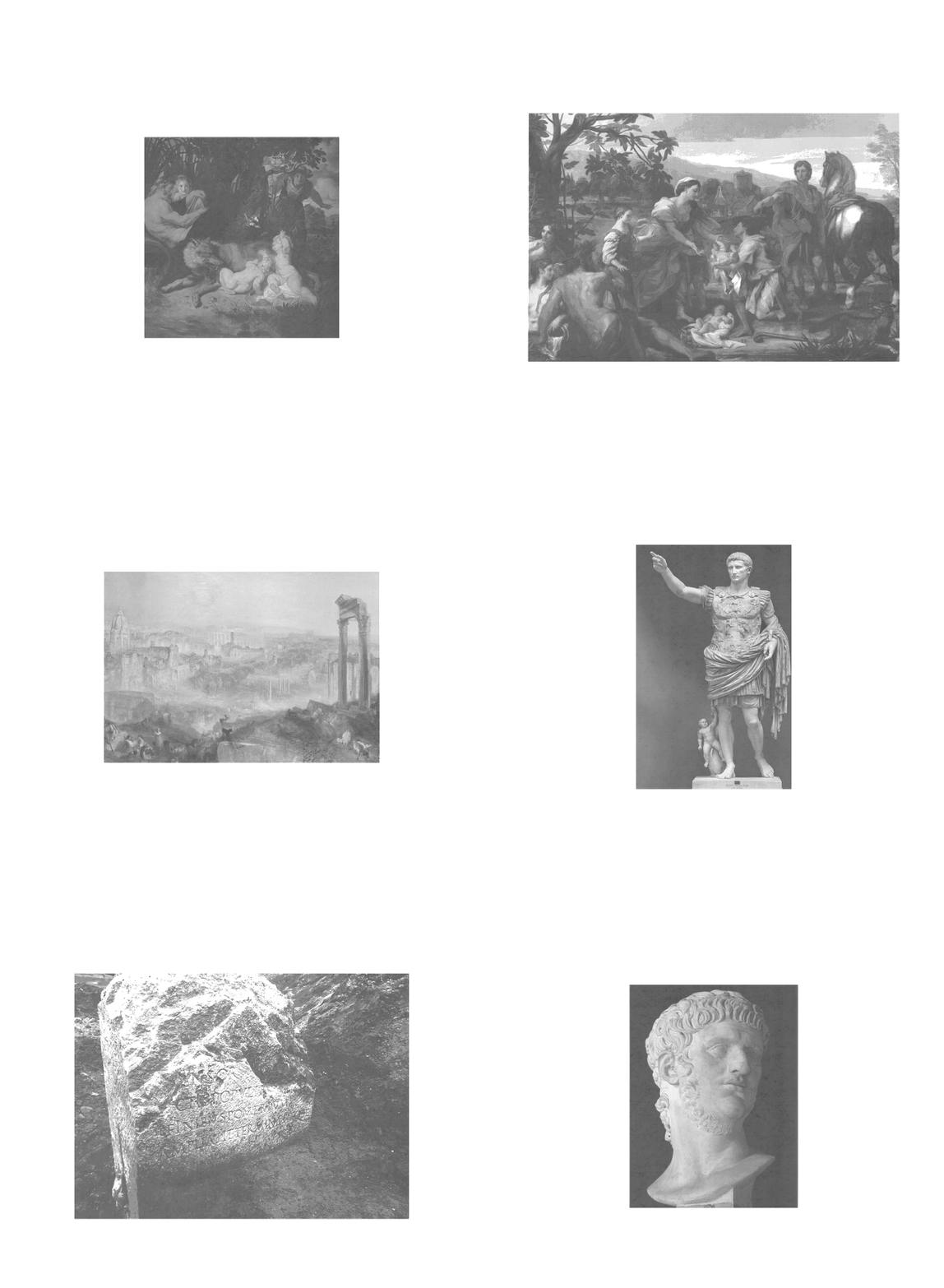
Remus and Romlus
Romulus stood on the Palatine Hill, his eyes
scanning the skies above. Not far away, on another
hill named Aventine, Romulus’ twin brother, Remus,
was also looking skyward. Each wanted to establish a
great city on the Italian peninsula, but they could not
agree on where it should be built. So they watched
and waited for a sign that would reveal which
brother would become the founder of the new city.
Tradition says that Rome was founded in
753 B.C. But to learn the full legend of Romulus and
Remus, we must go back to the end of the Trojan
War.
When the Greeks captured the city of Troy
(according to many scholars, sometime around 1184
B.C.), a Trojan warrior named Aeneas escaped and,
with a small band of soldiers, wandered throughout
the Mediterranean Sea region, finally settling on the
coast of Italy. Aeneas’ son founded a city named
Alba Longa, and for approximately four hundred
years a long line of kings reigned.
Eventually, rule of Alba Longa fell to a king
named Numitor. Although Numitor was the rightful
ruler, his younger brother Amulius took the throne
by force. To assure that Numitor would have no
descendants who could challenge him, Amulius forced
Numitor’s daughter, Rhea Silvia, to become a vestal
virgin. Such women were dedicated to Vesta, the
goddess of the hearth, and were not allowed to bear
children.
Rhea, however, had twin boys, claiming the
god of war, Mars, as their father. The twins were
named Romulus and Remus, and were “of more than
human size and beauty,” according to the Greek
biographer Plutarch (born before A.D. 50 and died
after A.D. 120). When Amulius learned of their birth,
he was furious and ordered them killed. A servant
placed the infants in a basket and set it adrift on the
Tiber River, where the boys would die of exposure.
Instead, the basket ran aground in shallow water.
The hungry cries of the babies attracted a female
wolf, who nursed Romulus and Remus and kept them
alive. A shepherd named Faustulus soon found the
twins and, with his wife, raised the boys in secret.
As young men, Romulus and Remus
had a wild streak, hunting dangerous animals and
ambushing robbers in order to share the thieves’
loot with their fellow shepherds. One day, during a
quarrel between Amulius and Numitor’s herdsmen,
Remus was captured and charged with stealing
cattle belonging to Numitor. Amulius decided to turn
Remus over to Numitor for punishment. In talking
with the young man, Numitor realized that Remus
was one of his long-lost grandsons. The two began to
plot to overthrow Amulius.
Meanwhile, Romulus was making his own
plans to rescue his brother. Gathering together a
small force, Romulus invaded King Amulius’ palace,
while Remus attacked from within. Amulius was slain,
and the throne was returned to its rightful owner,
Numitor. Romulus and Remus had helped restore
their grandfather’s kingdom, but now they grew
restless. They longed to build their own city at
the place by the Tiber where their basket had run
aground. But the brothers disagreed on the exact
location. Romulus chose a hill called Palatine as the
site, while Remus selected the Aventine. Ordinarily,
the wishes of an older brother would take priority
over a younger one, but, since Romulus and Remus
were twins, another way had to be found.
In ancient times, augury was the “science”
of receiving signs or omens from the gods by
observing natural phenomena such as lightning or
the behavior of birds and animals. Priests called
augurs were charged with interpreting such divine
messages.
Romulus and Remus decided to choose the
location of their city by watching for a flock of
birds. Each brother stood on a selected hilltop and
Remus was the first to see an omen: six vultures
flew over his hill. Remus and his followers rejoiced
at this sign, which they said qualified him as king.
Then word came that Romulus had seen a flight
of twelve vultures. The brothers argued about the
omens. Remus said his was the right one because
he had seen it first. Romulus proclaimed his omen
best because he had observed more vultures.
During the quarrel, Remus taunted Romulus by
jumping over the boundary of his proposed city.
Enraged, Romulus struck and killed his brother,
angrily shouting, “Any other who leaps over my
walls shall have the same!”
After burying his brother, Romulus began
building the city that would bear the name Rome,
after its first king. Tradition gives the date as April
21, 753 B.C., a day the Romans celebrated much as
we celebrate the Fourth of July. As for Romulus,
he lived a long life and one day disappeared in a
thunderstorm, after which the Romans associated
him with their god of war, Quirinus. It is, perhaps, a
fitting end for the legendary founder of the eternal
city called Rome.
The Founding
Rome was founded around 625 BC in the areas
of ancient Italy known as Etruria and Latium. It is
thought that the city-state of Rome was initially
formed by Latium villagers joining together with
settlers from the surrounding hills in response to
an Etruscan invasion. It is unclear whether they
came together in defense or as a result of being
brought under Etruscan rule. Archaeological evidence
indicates that a great deal of change and unification
took place around 600 BC which likely led to the
establishment of Rome as a true city
The first period in Roman history is known as the
Period of Kings, and it lasted from Rome’s founding
until 510 BC. During this brief time Rome, led by no
fewer than six kings, advanced both militaristically and
economically with increases in physical boundaries,
military might, and production and trade of goods
including oil lamps. Politically, this period saw the
early formation of the Roman constitution. The end of
the Period of Kings came with the decline of Etruscan
power, thus ushering in Rome’s Republican Period.
Rome entered its Republican Period in 510 BC. No
longer ruled by kings, the Romans established a new
form of government whereby the upper classes ruled,
namely the senators and the equestrians, or knights.
However, a dictator could be nominated in times of
crisis. In 451 BC, the Romans established the “Twelve
Tables,” a standardized code of laws meant for public,
private, and political matters.
Rome continued to expand through the
Republican Period and gained control over the entire
Italian peninsula by 338 BC. It was the Punic Wars
from 264-146 BC, along with some conflicts with
Greece, that allowed Rome to take control of Carthage
and Corinth and thus become the dominant maritime
power in the Mediterranean.
Soon after, Rome’s political atmosphere
pushed the Republic into a period of chaos and civil
war. This led to the election of a dictator, L. Cornelius
Sulla, who served from 82-80 BC. Following Sulla’s
resignation in 79 BC, the Republic returned to a state
of unrest. While Rome continued to be governed as a
Republic for another 50 years, the shift to Imperialism
began to materialize in 60 BC when Julius Caesar
rose to power.
By 51 BC, Julius Caesar had conquered
Celtic Gaul and, for the first time, Rome’s borders
had spread beyond the Mediterranean region.
Although the Senate was still Rome’s governing
body, its power was weakening. Julius Caesar was
assassinated in 44 BC and replaced by his heir, Gaius
Julius Caesar Octavianus (Octavian) who ruled
alongside Mark Antony. In 31 BC Rome overtook
Egypt which resulted in the death of Mark Antony
and left Octavian as the unchallenged ruler of Rome.
Octavian assumed the title of Augustus and thus
became the first emperor of Rome.
Rome’s
Imperial Period was its last, beginning with
the rise of Rome’s first emperor in 31 BC and lasting
until the fall of Rome in AD 476. During this period,
Rome saw several decades of peace, prosperity, and
expansion. By AD 117, the Roman Empire had reached
its maximum extant, spanning three continents
including Asia Minor, northern Africa, and most of
Europe.
In AD 286 the Roman Empire was split into
eastern and western empires, each ruled by its own
emperor. The western empire suffered several Gothic
invasions and, in AD 455, was sacked by Vandals.
Rome continued to decline after that until AD 476
when the western Roman Empire came to an end.
The eastern Roman Empire, more commonly known as
the Byzantine Empire, survived until the 15th century
AD. It fell when Turks took control of its capital city,
Constantinople (modern day Istanbul in Turkey) in
AD 1453.
Romans Influence
Etruscan rule left its mark on early Roman art.
Many of the remaining paintings from this era are
located in tombs, such as those found at Tarquinia.
One painting from this complex, found in the Tomb of
the Leopards, portrays an Etruscan banquet scene and
dates from 400’s BC. On the main panel, servants are
shown bringing food and wine while musicians provide
entertainment. On the top panel, leopards are depicted
in between bits of greenery. Both people and animals
are painted primarily in profile. The cheerful tone of
this painting reflects the realities of everyday life, a
common theme in Etruscan art.
The Etruscan monarchy ended with the
establishment of a Republican government in 509 BC.
Most of the paintings from this era come from ancient
villas where the most affluent Romans lived. Art
scholars have classified these paintings as indicative
of four distinct styles. The First Style demonstrates
how Roman painters mimicked certain kinds of stone,
like marble. Paintings in the Second Style show
entire scenes on the wall, drawing the observer into
another world. Oftentimes, the subjects of Second
Style paintings are scenes from mythical stories. Third
Style paintings show a single miniature mythical
scene floating in a void of one color and framed by
an architectural structure, such as columns connected
by canopies. The Fourth Style is a combination of the
first three.
Wall paintings in the Ixion Room in the
House of the Vettii in Pompeii date back to 70 AD.
These paintings demonstrate how the elements of the
first three styles were used to create the Fourth Style.
The top and center panels show the architectural
scenes of buildings with Greek and Roman design
characteristic of the Second Style. The center panels
also include the Third Style painting that has one
color for a background and a small scene floating in
the middle, framed by a dainty border. On the very
bottom, the panels are made in the First Style, painted
to appear like the marble seen in Greek and Etruscan
palaces. The fusion of the three styles highlights the
multiculturalism inherent in Roman society.
Portraiture was another form of painting
in ancient Rome. In the province of Egypt, the old
masks that once adorned mummies and gave identity
to the dead were replaced with Roman style portraits
displaying realistic faces with large round eyes.
A portrait painting of Septimius Severus and his
immediate family, painted on wood with tempra paint,
is the only currently existing depiction of an emperor.
The work came from Faiyum, Egypt in the third
century AD. The royal family is shown wearing their
fine jeweled crowns. Each person has a hint of a smile,
and his or her eyes are typically large and round.
Septimius Severus’ eyes are the most distinct and
lifelike in the painting. The face of the eldest son, Geta,
was scratched off, most likely ordered by his younger
brother, Caracalla, who succeeded Geta.
Paintings with Christian subjects also
exist from the latter half of the imperial period of
Roman history. During the time when Christianity
was outlawed, many Christians were driven to the
catacombs under Roman streets where the dead were
kept. One painting on the ceiling of Saints Peter
anduse of symbolism in Christian artwork. The ceiling
painting is octagonal shaped, with eight scenes that
tell the story of the Bible character, Jonah. Christ
is depicted in the center of the octagon because
early Christians viewed Jonah as a precursor to
Jesus Christ. This and other paintings found in the
catacombs do not demonstrate masterful art because
there was very little light by which to see and artists
had to endure the stench of dead bodies as they painted
The early Romans and Etruscans did not use
the medium of mosaic, but there are examples of
Republican mosaics found in Roman homes. In the
House of Neptune and Amphrititie (c. 62 AD) in
Herculaneum, a wall mosaic was made in the same
form as that of the Second and Third Style wall
paintings from the same era. This mosaic depicts
two statue-like versions of Neptune and his wife,
Amphrititie, standing against a white background. They
are surrounded by an architectural frame and laid on a
background of blue, to represent the sea.
Imperial Rome also made use of mosaics.
One example of a floor mosaic was found in the
Baths of Neptune (C.140 AD) in Ostia. The sea god
is portrayed riding a horse-drawn chariot. The god
is surrounded by figures of men and sea creatures
swimming about. The figures are black, and thus
stood out against the white background. This work is
reminiscent of Greek vases.
The early Roman Christians made many
mosaics with the general purpose of teaching the
observer about their beliefs and stories. A mosaic
found in the mausoleum of Julii in Rome, constructed
in the late 200s AD, portrays Christ as Sol Invictus
(Invincible Sun), a god known to the Greeks as Helios.
Christ is shown driving the sun chariot and a halo
surrounds his head like rays of sunlight. Vines of
green leaves surround him. This example depicts
the manner in which Christian artists overlapped
symbolism from the prevailing pagan cultures to
establish the character of Christ.
Another depiction of Christ in a mosaic
form can be found in the mausoleum of Galla Placidia
in Ravenna. Made in c. 325 BC, it was found at the
entrance of the mausoleum. Christ is shown in a
pastoral scene as a shepherd, much like the figures
found in the catacomb painting from Rome. However,
changes were made to represent some of Christ’s
attributes. Instead of being shown as a poor shepherd,
he wears royal colors of purple and gold. He is
holding a cross instead of a shepherd’s crook and has
a halo around his head. A group of three sheep sit on
either side of him.
Statuary and relief sculptures from ancient Rome
have survived through the ages more intact than most
paintings. Roman sculpture made use of a variety
of materials such as concrete, marble, and bronze.
and even scenes from everyday life. Roman stone
work was influenced heavily by Greek art, which was
detailed and free flowing in character. However, Roman
statuary generally looked more rigid than its Greek
counterpart.
Etruscan statuary and sculpture was another
basis for Roman sculpture. A sarcophagus found
at the necropolis at Cerveteri demonstrates typical
Etruscan stone work. The terra cotta sarcophagus is
shaped like a banqueting couch, and the lid includes
a depiction of a husband and wife reclining. Another
famous example of Etruscan or early Roman art is
the bronze statue of the Capitoline Wolf nursing two
small infants. It portrays the beginning of the story of
the foundation of Rome. The two babies, Romulus and
Remus, were orphaned and raised by a she-wolf. They
eventually established the city of Rome. Some mistake
it as Republican art because the mythical characters
became the rallying symbol of the new Republic after
the Etruscan kings were forced from leadershi p in
Rome..
Imperial statuary followed a realistic style
also. A statue depicting the general Augustus as
a general, made c. 20 BC and found in the villa of
his wife Livia, demonstrates the similarity between
Republican and Imperial art. Augustus’ life-like face
suggests strength, as does his muscular body and
military attire. His hand is raised as though he were
addressing his soldiers with authority. At one foot of
the statue is a depiction of a small Cupid, referring to
the claim of the Claudian family that they could trace
their ancestry back to the goddess, Venus. The statue
of Augustus served as political propaganda for the
upper classes of Rome. It was intended to impress
those who saw it, stressing the emperor’s power. Some
scholars believe that it may have been constructed
after his death and that it worked to uphold the
memory of his achievements.
The arch of Titus was built after 81 AD
and memorialized the emperor Titus in the relief
sculptures found on its sides. The scenes on the arch
also encourage belief in the power of the emperor’s
military prowess. One relief, called the Spoils of
Jerusalem, depicts the Roman soldiers taking treasures
out of the Jewish Temple in Jerusalem. Before
becoming emperor, Titus worked to quiet the Jewish
uprisings in the Middle East. He destroyed the Temple
in Jerusalem when his armies took the city in 70 AD.
The relief sculpture depicts the soldiers carrying their
looted treasures, such as a gold menorah. All of the
relief sculptures on the arch show numerous soldiers
on the move. The sun casts shadows on the relief,
making the work appear more vibrant and realistic.
Another imperial statue, found on an outside
corner of San Marco in Venice, exemplifies a new
philosophy in Roman leadershi p. The statue depicts
the tetrarchy formed by Diocletian to help administer
the large empire. The statue was made of porphyry
(purple marble) around 300 AD. It shows four rulers
of the Roman Empire huddled together in two pairs.
Each individual reaches an opposite arm to clutch the
shoulder of his companion, indicating that the rulers
relied on one another. All four are clutching a sword
handle with their free hand. The faces of the statues
lack the certainty and confidence of past statues of
leaders nor do they display any emotion. The entire
composition seems stiff and conveys a feeling of
anxiety.
In the latter Imperial period, a statue of
Constantine, the emperor who made Christianity legal,
indicates a shift from the tension of the tetrarchy.
The colossus statue of the enthroned emperor
was constructed in 315 AD and stood 30 feet high
in the Basilica Nova in Rome. The huge head of
ConstantineW stands eight and a half feet high and
has a strong face with characteristically large eyes
that display a knowing and wise expression. The
entire composition was intended to remind an ancient
observer of the god Jupiter. In one hand, Constantine
held an orb, a symbol of worldly power. In the other,
he held a Christian cross. This statue’s purpose was to
show his absolute authority and was part of his hero
worship. It encouraged confidence in the emperor
during this time of constant barbarian invasion at the
borders and the conversion to a new religion.
Roman coins were hand-made using a variety
of metals. The type of metal used and its weight
determined the value of a coin. Emperors ordered their
silhouettes placed onto coins along with their names
and titles in abbreviated form. Mythical beings would
most often appear on the backs of coins to represent
an event or a battle. Both the titles and events
represented in short form were a tool of propaganda
for emperors.
In 44 BC, Julius Caesar became the first
emperor to have his likeness immortalized on a coin.
On one coin from the era, Julius Caesar’s silhouette
shows his receding hairline, a symbol of wisdom during
the Republic. On the back of the coin, he demonstrates
his military power with a picture of the goddess
Venus in her military role.
One coin minted from Augustus’ reign
symbolizes his strength. This denarius from 19 BC
shows a Parthian soldier kneeling. In his raised hand
is a Roman standard, which is a symbol used by the
Roman Army. This picture symbolizes Augustus’
success in negotiating the return of Roman military
standards, as well as obtaining land that the Parthians
had recently won.
An aureus dating from c.64 AD, minted during
Nero’s rule, conveys a different message. It was minted
soon after the military tried to kill the emperor and
replace him with Piso. Nero learned of the conspiracy
before it could be carried out. His portrait is shown on
the front side of the coin. This realistic picture of the
emperor does not conceal his weight, showing his large
neck and fat face. On the other side of the coin is
Jupiter, whom Nero believed was a sort of patron god
and protector.
The Fall
At its peak in 117 CE, the
Roman Empire covered some 2.3
million square miles (5.9 million
square kilometers) over three
continents, Africa, Asia, and Europe.
It is estimated that perhaps 60
million people lived within its
borders. It was one of the largest
and most powerful empires in
the ancient world. However the
empire could not maintain this
size. Within a few decades of
Emperor Trajan’s death in 117
CD, Mesopotamia was lost to the
Parthians of ancient Iran. The
Romans would never again hold
Mesopotamia.In Europe, the long
border through heavily wooded
Germania proved too expensive
to defend, forcing the Empire to
concede land to German tribes and
pull back to the Rhone and Danube
Rivers.
When Diocletian became the
Roman Emperor in 284 CE, he
inherited an empire on the verge
of collapse. He was preceded
by several weak rulers who
rose too quickly and were often
assassinated. International trade
networks were failing and the vast,
connected world of the Roman
Empire almost disappeared. When
Diocletian took charge, he brought
about a series of changes to save
his empire. Most of these changes
would not last long past his death,
but he did bring about some muchneeded
stability. In the West, the
empire would limp forward for
another century and a half, while
in the East, it would reign for over
a millennium.
Diocletian created the tetrarchy
which divided the empire
between four rulers: two senior
emperors and two junior ones.
Together they would rule the
vast empire. Yet soon after his
death in 311 CE, the rulers were
back to fighting each other for
control. Constantine the Great
(ruled 306–337 CE) would
emerge as the victor. Under
Constantine, Christianity became
legal and eventually the dominant
religion. The new capital city
Constantinople (modern Istanbul,
Turkey) was created as if it were
the New Rome. This was in the
eastern part of the empire, which
was much wealthier and more
stable.
Things went downhill for the
next 140 years, especially over
in the west. Power was often
in the hands of child emperors,
who were guided by generals.
The economy was in shambles as
international trade dramatically
declined. The Vandals under
their king Gaiseric (389–477 CE)
took over North Africa and cut
off the Western Roman Empire
from its main source of grain.
Within the empire, markets became
more localized. This made it a
lot harder for the government
to collect the taxes it needed
for its vast armies. Throughout
Europe, Germanic tribes began to
push into the empire, often driven
there by the hope for safety and
security against forces such as
Attila the Hun. In the West, these
forces became too strong to resist.
Then in 476 CE the last emperor,
Romulus Augustulus, was deposed
at the age of 16.
In 212 CE, the emperor
Caracalla published the Antonine
Constitution. It gave citizenshi p to
all free men within the borders of
the Roman Empire, no matter how
far from Rome they lived. The idea
of Roman identity, or romanitas
was pushed hard through education
and government. Everyone who
lived on the other side of the
borders were non-Romans, looked
down on as barbarians. This sense
of social superiority was most
evident in how the Romans dealt
with the Germanic tribes. In 350
CE, German groups were trying to
migrate into the Roman Empire,
but while the Romans would use
them as troops, these Germans had
little chance of being accepted
as “Roman.” But Germans would
soon prove you didn’t have to be
Roman to learn the romanitas way.
In 375 CE, the emperor Valentinian
I met with German tribal leaders
from the Quadi. The Quadi had
previously attacked Roman forces
that had crossed the Danube River.
They explained to the emperor
that this was because he had
set up military camps along the
river in their territory, creating a
barrier against them. He was so
insulted by the blame that they
placed on him for their actions
that he “burst into a mighty fit of
wrath,” suffered an aneurysm and
died. Three years later, in 378 CE, a
confederation (group) of German
tribes defeated the Romans at the
Battle of Adrianople in the Balkan
Peninsula and killed the emperor
Valens. This battle was the result
of a series of abuses suffered by
Germans at the hands of Roman
officials. The confederation was
then united as the Visigoths under
its first king, Alaric. Alaric and his
subjects were repeatedly denied
safe refuge or recognition as
citizens, simply because they were
Germans. Alaric and the Visigoths
fought back by sacking Rome in
410 CE. When the Western Roman
Empire fell in 476 CE, it was
replaced by a series of kingdoms
ruled over by the very Germans
that the Romans so despised. Yet,
even as Rome fell, it spread its
romanitas to the Germanic tribes.
There is no small irony in how the
Germanic kingdoms that arose in
Western Europe after 476 CE, as
well as the increasingly powerful
Catholic Church, were modelled
after the Roman Empire. In that
sense, Roman traditions continued
long after Rome’s fall.
In 1984 A. Demandt published
a list of 210 reasons historians
have given for the fall of the
Roman Empire. The list points
to everything from taxes to
hypothermia to public baths, but
most likely there were many
causes. Internally the empire was
failing economically. It had lost its
tax base and long distance-trade
was cut off. The people of the
Western Roman Empire became
disconnected from the emperor,
living in small, localized, selfsufficient
communities that couldno longer rely upon their emperor
to care for and protect them.
Externally, outsiders like those
Germanic tribes were crossing
into the empire in ever larger
numbers. Many probably just
wanted to join Rome, not invade
or destroy it, but the Romans
continued to despise them.
Beyond asking why it fell, it’s
important to ask what the fall of
Rome meant to historians. Some
see it as catastrophic. Looking at
the ruins of Rome these historians
see the fall of Rome as the violent
and bloody end of a civilization,
pushing Europe into a Dark Age
that was primitive and barbaric
compared to earlier life under the
Roman Empire. Others look at the
fall of Rome as a period transition.
While the central authority of
the Western Roman Emperor
disappeared in 476 CE, Roman
institutions, from the Catholic
Church to Roman law, continued in
the Germanic kingdoms that came
afterwards. The Eastern Roman
Empire survived this difficult
period and continued on as the
Byzantine Empire until its fall in
1453 to the Ottomans. It survived
where the West did not for a
variety of reasons, most notably
its society was more cohesive,
its tax base was stronger, and its
location provided it with somewhat
better protection against Germanic
incursions.