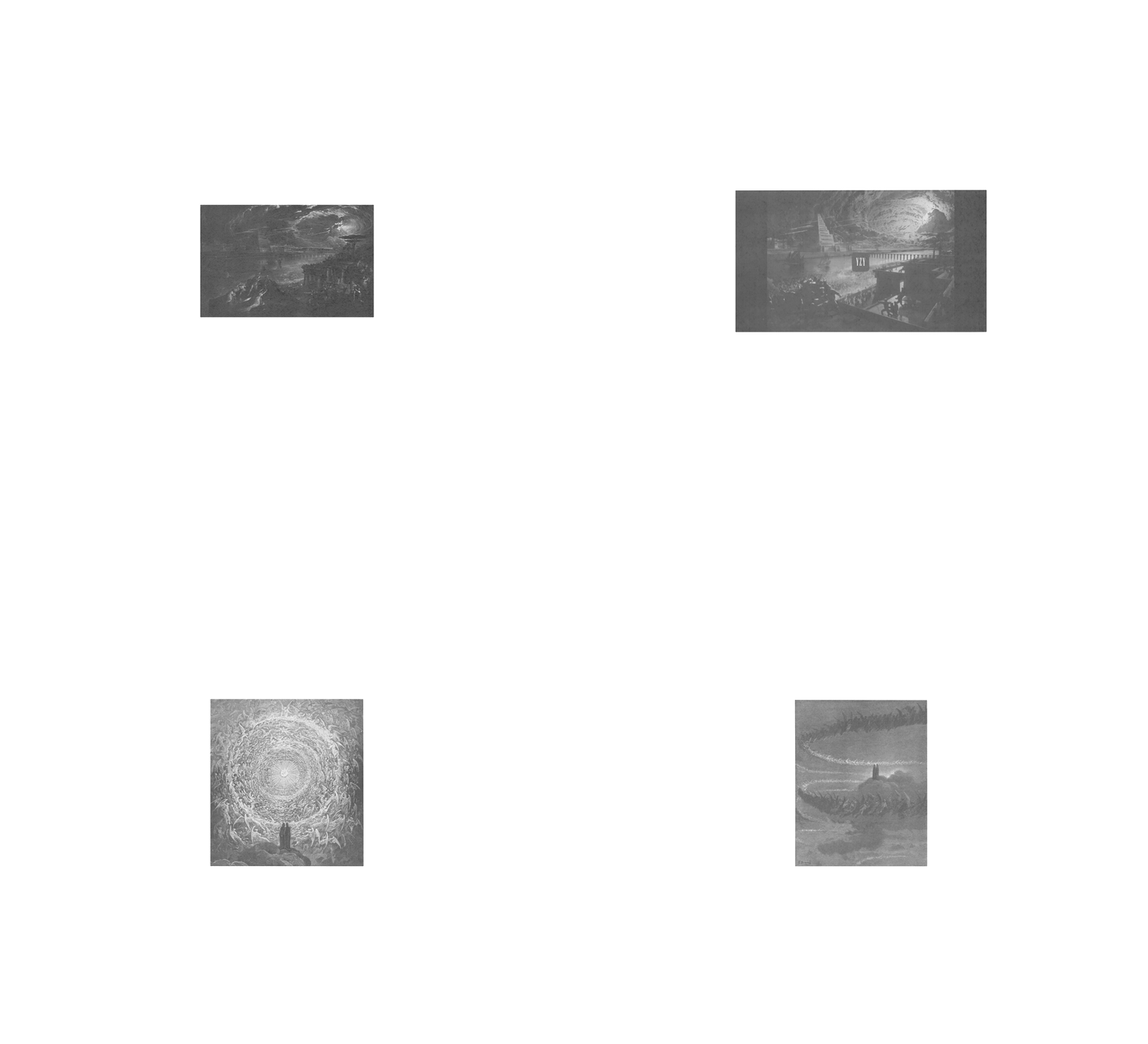
Painting the Apocalypse
On the night of 1 February 1829, Jonathan Martin felt his way from
behind Archbishop Greenfield’s effigy in the north transept of York
Minster. “All was darkness: I could not see my hands before me,” he
later told the court. Using bell ropes as an improvised rope ladder, he
clambered into the choir, prayed awhile, gathered hassocks and selected
books into piles and set them alight. “I thought it a work of merit to burn
prayer-books and music books,” he explained, “but not to burn the Word
of God.”
Around eight the following morning flames burst through the
roof. Horrific though the scene was, the people of York took to marvelling.
One onlooker wrote of “an effect indescribably beautiful and grand”.
Another, an enraptured lady, was moved to cry out: “What a subject for
John Martin!”
By then the fire-raiser was well on his way northwards to his
place of origin in the Tyne valley, where he was soon arrested. At his trial
back in York the following month he laughed a lot and was found insane.
“I have made as much noise as Bonaparte ever did, I think,” he remarked
to the court. In the lunatic asylum of Bedlam – where the Imperial War
Museum now stands – he remained cheerful, drew imaginatively and gave
no trouble. He died 10 years later.
Two elder brothers, William and Richard, attended his trial but,
although he paid for the defending counsel, Henry Brougham (a future
lord chancellor), John – seven years Jonathan’s junior – stayed in
London where he had a large family, an establishment to maintain and a
reputation to lose. Hadn’t Sir Thomas Lawrence once toasted him, tongue
slightly in cheek, as “the most popular painter of the day”? As it was, the
notorious Jonathan, the most celebrated arsonist of the age, was rivalled in
fearless assertion and eccentricity by both Richard, a visionary-minded poet
Bridge on the Tyne in 1789, he grew up in frontier landscape a couple
of miles south of the Roman wall. His mother was pious, his father
erratic and his elder brothers no doubt inspired in him notions of
fervent self-expression. By 1806 he was in London, edging into artistry
by executing picturesque views on china plates. He was perky, engaging,
sociable, tireless, and his ambitions grew as he progressed through classical
landscapes, scenes from Ovid’s Metamorphoses and suchlike, on to the
lofty plateaux of history painting, winning attention at the Royal Academy
and its rival body the British Institution with increasingly startling
compositions. There was Sadak in Search of the Waters of Oblivion (tiny
figure scrambling on to a rock shelf) and The Bard (tiny figure on a high
rock in Snowdonia cursing the occupying army of Edward I), followed by
Joshua Commanding the Sun to Stand Still (tiny figure persuading God
to halt time for long enough to get the walls of Jericho to collapse).
Grander compositions followed. The Fall of Babylon (1819) and its sequel,
Belshazzar’s Feast (1820), were scenes of panic in the vastnesses of what
the artist assured his audience were authentic period settings. By this
stage Martin had become aware of the advantages of making pictures
phenomenal enough to rate entrance charges. The plagues of Egypt, the
destruction of Herculaneum and Pompeii, the overthrow of Nineveh:
all received the meltdown treatment. Unlike ordinary history paintings
manned by statuesque protagonists, his big pictures played to a taste for
disasters involving seething multitudes.
Martin enjoyed popular success for well over a decade.
Discovering that the larger the picture the trickier it was to sell, he took
to producing mezzotint versions, affordable for those lacking stately homes,
producing them himself in his house in Allsop Terrace, near Regent’s
Park. Mezzotint proved the ideal medium for him: plates roughened to
hold the ink, scraped to create light. Commissioned in the 1820s to do
illustrations for Paradise Lost, he produced two sets, each plate a hymn
to Milton, ranging between the silvery glades of paradise and the black
infinities of Satan’s underworld. Thence he surveyed the epochal past,
summoning up in paint and print two of the most dramatic moments
ever imagined: the breached river wall and death of Sardanapalus in
The Fall of Nineveh, and the rocks tumbling amid lightning strikes and
torrential swirls in The Deluge. These he worked on, coincidentally, over
the months that Jonathan Martin spent dreaming up what he called his
“job”, the torching of York Minster, during which time he wrote an open
letter in prime Tyne dialect: “I right Oh Clargmen to you to warn you to
fly from the roth to cum you who are bringing a Grevus Cors upon the
Land …”
At the height of his fame, John Martin was described by an
acquaintance as well spoken and dapper, making him sound like an eager
minor character in early Dickens: “light primrose-coloured vest with
bright metal buttons, a blue coat set off with the same, his hair carefully
curled and shining with macassar. He kept to his points with a tenacity
not hastily subdued.” Ardent for attention and respect, Martin moved
freely in London society; he became friendly with Michael Faraday and
Charles Babbage, the computer pioneer. And even after a period of
setbacks – falling sales for the prints and the frustration of various
projects – in 1840 he was reputable enough to attract Prince Albert to his
studio, there to commission and discuss The Eve of the Deluge. This was
to be the prince consort’s preferred sort of painting: foreboding picked out
in admirable detail, limpid atmosphere overall.
Martin’s world, a world of crusty foregrounds, of cities
constructed on clean lines and bright blue distances, was a world for
ever under threat. His brother William, 17 years older, had been ahead
of him for decades in exercising an appetite for reordering the planet.
Self-taught and wonderfully self-confident, he developed a perpetual
motion mechanism